

Quick Summary
To reinforce gazebo frame structures for winter, first tighten every bolt and check that the frame is square, then add diagonal cross-bracing between opposite legs and anchor each leg to the ground. Winter snow and wind push on the frame joints, so bracing keeps them from racking, and anchoring stops the whole structure from lifting.
- Inspect bolts, corner joints, and frame metal for rust, cracks, and loose fasteners before adding any reinforcement.
- Measure both diagonals at the top rails; they should match within about 1/4 inch before you brace.
- Mount diagonal braces from the lower part of one leg to the upper part of the opposite leg on each open side.
- Attach a tie-down strap or cable to every leg, matched to your surface type such as grass, concrete, or deck.
- Bracing and anchoring do not raise the manufacturer's snow load rating, so clear snow early with a soft broom.
Table of Contents
- Why Winter Loads Stress a Gazebo Frame
- Inspect Fasteners, Joints and Frame Metal Before Winter
- How to Anchor a Gazebo for High Winds
- Step-by-Step: Adding Cross-Bracing and Winter Reinforcement
- Gazebo Snow Load Capacity and When to Clear Snow
- How to Remove a Gazebo Canopy for Winter
- Gazebo Frame Repair After Wind Damage: Repair or Replace
- Getting the Right Replacement Parts Before Your Next Storm Season
- Frequently Asked Questions
Why Winter Loads Stress a Gazebo Frame
Winter adds weight and force that a summer gazebo never has to handle. Snow sits on the canopy, ice forms on the fabric, and gusts push hard against the sides.
Most gazebo frames are built for sun and light breezes. They are not built to carry a heavy snowpack. A frame that flexes a little in summer can bend or buckle under winter weight.
Watch for these warning signs:
- Sagging or dipping in the center of the roof
- Gaps opening at the corner joints
- Legs that shift or lean after a storm
Inspect Fasteners, Joints and Frame Metal Before Winter
Start with a full inspection before you add any reinforcement. Reinforcing a weak joint does little good if the joint is already failing.
Check each of these areas:
- Bolts and screws: Tighten any that have loosened. Replace stripped or rusted fasteners.
- Corner and leg joints: Look for cracks, wiggle, or gaps. A joint that moves is a joint that will fail.
- Frame metal: Look for rust, flaking paint, and dents. Rust weakens steel quickly, especially at the base of legs.
A common mistake is tightening a bolt that is already stripped. The threads will spin and give you a false sense of security. Replace the fastener instead.
How to Anchor a Gazebo for High Winds
Wind is often the bigger threat than snow. A light gazebo can lift and tip even when the weather looks calm. Anchoring keeps the whole structure grounded.
Anchoring methods depend on your surface:
- Grass or soil: Use ground stakes or auger anchors driven deep into the earth.
- Concrete patio: Use concrete anchor bolts or weighted tie-down brackets.
- Wood deck: Use deck anchors or lag bolts that attach to the deck framing, not just the boards.
Attach a tie-down to every leg. Use a strap or cable rated for outdoor use, and keep it snug without bending the frame.
Step-by-Step: Adding Cross-Bracing and Winter Reinforcement
Cross-bracing can help reinforce gazebo frame structures against winter loads, because it converts a racking frame into a triangulated one. Wind pushes sideways on the legs; snow pushes down on the roof rails. Bracing addresses both by stopping the joints from rotating.
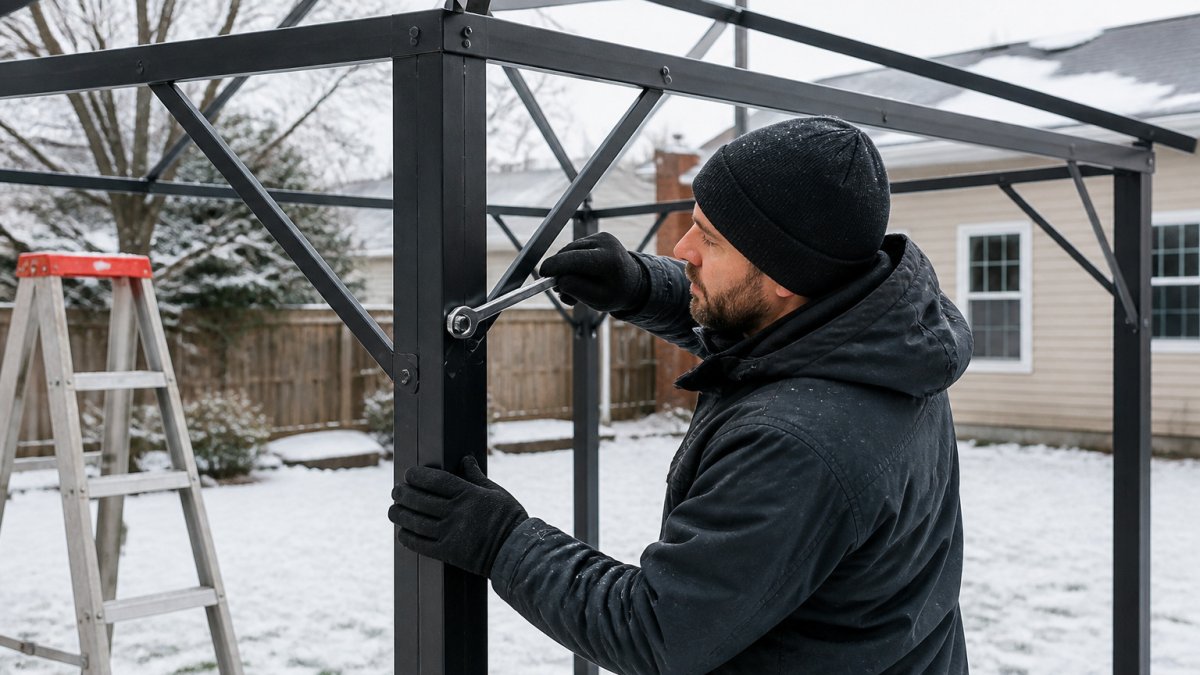
Work through these steps in order. Skipping ahead, especially adding braces before tightening fasteners, can lock a crooked frame into place.
- Clear and dry the frame. Remove snow, ice, and debris. Work on a dry, mild day if possible; cold metal is more brittle and harder to torque accurately.
- Tighten every fastener first. Snug all bolts and screws to the manufacturer's recommended torque. If no torque spec is available, tighten until the joint is firm with no visible gap, then stop, do not crush the tubing.
- Check the frame is square. Measure diagonally from corner to corner at the top rails. Both diagonals should match within about 1/4 inch. If they do not, loosen the joints, rack the frame square, and retighten before bracing.
- Install diagonal braces between opposite legs. Mount from the lower part of one leg to the upper part of the opposite leg on each open side. This resists side-to-side sway.
- Add a top-rail brace or winter bar. An extendable brace across the top rails stiffens the roof plane and helps the frame share snow load across all four legs instead of one.
- Re-check square and re-torque. After bracing, re-measure the diagonals and re-tighten any fastener that loosened during installation.
Material-Specific Bracing Methods
The right brace and fastener depend on the frame material. Using the wrong combination can crush thin tubing or strip soft metal.
- Steel frames: Use steel diagonal braces or adjustable turnbuckles with forged eye bolts. Steel is strong but rust-prone, use galvanized or powder-coated hardware, and apply touch-up paint to any drilled hole. Do not drill through a welded joint; drill through the flat of the tube instead.
- Aluminum frames: Aluminum is lighter and softer, so use aluminum braces or stainless-steel fasteners with nylon washers to reduce galvanic corrosion. Avoid over-tightening; aluminum threads strip easily. Rivet nuts or self-drilling screws with sealing washers work better than lag bolts in thin-wall aluminum.
- Wood frames: Use galvanized steel L-brackets, mending plates, or diagonal wood braces fastened with structural screws. Pre-drill to avoid splitting, and treat any cut or drilled area with an exterior wood preservative. Check for rot before bracing, a brace bolted to soft wood will pull out under load.
Adding Diagonal Braces and Low-Mounted Ballast
Diagonal braces resist the racking force that wind applies to a gazebo. Mount them from the lower part of one leg to the upper part of the opposite leg, and use two braces per open side where possible so the frame resists wind from either direction.
Ballast works from the bottom up. Weighted bases placed on each leg keep the structure from lifting. Sandbags or weight plates rated for outdoor use work well.
Anchoring by Surface Type
Bracing stiffens the frame, but the frame still has to be tied to something solid. The right anchor depends on what the legs sit on.
- Soil or grass: Use auger anchors or long ground stakes driven at an angle, not straight down. Angle them away from the gazebo so tension pulls against undisturbed soil.
- Concrete patio: Use concrete anchor bolts or wedge anchors drilled into the slab. If drilling is not an option, use weighted tie-down brackets with ballast.
- Pavers or gravel: These surfaces shift, so anchors alone may pull loose. Use weighted bases plus tie-downs, and consider a perimeter frame or ballast tray that spreads load across the surface.
Attach a tie-down to every leg. Use a strap or cable rated for outdoor use, and keep it snug without bending the frame.
Gazebo Snow Load Capacity and When to Clear Snow
Every gazebo has a snow load limit set by the manufacturer, and that limit is the number that matters, not how sturdy the frame looks after reinforcement. Reinforcement can help a frame carry load more evenly, but it does not turn an unrated structure into a rated one.
How to Find Your Snow Load Rating
Check these sources in order:
- Owner's manual or assembly instructions. Look for a snow load or roof load specification, often listed in pounds per square foot (psf) or as a total roof load in pounds.
- Product listing or manufacturer website. Search your model number plus 'snow load' or 'roof load.'
- Customer service. If the rating is not published, contact the manufacturer and ask for the design snow load in writing.
If you cannot find a rating, treat the structure as light-duty and clear snow early and often. A common pattern is that soft-top and pop-up gazebos carry far less snow than hardtop models, but the only reliable number is the one from your manufacturer.
Warning Signs That Snow Load Is Too High
Watch for these signals during and after a storm:
- Sagging or dipping in the center of the roof
- Gaps opening at corner joints
- Legs that lean or shift
Any of these means the load is already too high. Clear snow immediately and inspect the frame before using the gazebo again.
When and How to Clear Snow Safely
Clear snow when it builds up on the canopy, and clear it after a heavy storm, even if the accumulation looks light, because wet snow and ice weigh far more than dry powder.
- Use a soft-bristled broom or a roof rake with an extension handle.
- Work from the ground. Never climb onto the frame or roof.
- Pull snow down and away from the roof; do not push it across the canopy.
What Reinforcement Can and Cannot Do
Bracing and anchoring help a frame share load and resist wind, but they do not increase the manufacturer's snow load rating. If your area regularly sees heavy snow, the safer path is to remove the canopy for the winter or choose a model with a published snow load rating that matches your local conditions. Local building codes may also set snow load requirements for structures; check with your local building department if you are unsure whether your gazebo counts as a structure that must meet a code.
The table below summarises the key snow load and warning-sign facts covered in this section.
| Item | Value or sign | Note |
|---|---|---|
| Snow load rating | Set by manufacturer | Check manual, product listing or customer service |
| Rating units | Pounds per square foot (psf) or total roof pounds | Look for 'snow load' or 'roof load' |
| Sagging roof | Dip in roof centre | Load already too high; clear snow now |
| Joint gaps | Gaps at corner joints | Frame is overloaded or weakened |
| Legs shifting | Legs lean or move | Inspect frame before further use |
| Clearing tool | Soft broom or roof rake | Work from ground; never climb the frame |
| Clearing timing | Early and after heavy storms | Wet snow weighs far more than dry powder |
How to Remove a Gazebo Canopy for Winter
Taking the canopy off protects it from snow, ice, and UV damage. It also reduces the load on the frame during winter.
- Let the canopy dry completely before you fold it.
- Remove the fasteners that hold the canopy to the frame, keeping them in a labeled bag.
- Fold the canopy loosely and store it somewhere dry and cool.
- Store the frame sections out of the weather, or cover them with a breathable tarp.
Avoid storing fabric in a sealed plastic bin while it is damp. Mildew can form quickly.
Gazebo Frame Repair After Wind Damage: Repair or Replace
After a storm, decide whether a part can be repaired or needs replacing. Bent tubes can sometimes be straightened, but a cracked or kinked section usually has to go. Rust that has eaten through the metal is a replacement job.
Repair is reasonable when:
- The damage is limited to one bent or scratched component
- The joints still hold firm
- The metal is solid without deep pitting
Replace the part when:
- A tube is cracked, split, or kinked
- Rust has weakened the metal
- Repeated repairs keep failing
If you are unsure, a damaged frame is safer replaced than patched. Removing rust from a frame before you decide can show how much metal is left.
Getting the Right Replacement Parts Before Your Next Storm Season
Replacement parts are easier to source before the next season starts. Start by identifying your gazebo model, then match each damaged piece to the correct part.
For a complete frame, browse Lowes Gazebo Frame Parts to find components for your model. If you need a specific connector, the TPGAZ17-002 hook PART I is one option to check.

Have your model number ready before you order. It prevents the wrong part from arriving and saves you a return.
Frequently Asked Questions
Do gazebos hold up in the winter?
Many gazebos can stand through winter if the frame is sound, anchored and braced, but the canopy and roof are the weak points. Snow and ice add weight that a fabric top or light frame was not built to carry for long. Remove the canopy, clear heavy snow from the roof when it is safe to do so, and inspect fasteners in spring. Check your manufacturer's load rating before the season starts, since it sets the real limit for your model.
How much snow can a gazebo roof safely hold?
The safe limit depends on your gazebo's manufacturer load rating, which is usually printed in the manual or product listing. Without a stated rating, assume a light frame can carry far less than a heavy-duty steel one. Remove snow when it is deep or wet, and never climb onto the roof to clear it. Use a long broom or a soft-tipped roof rake from the ground instead.
Should I remove the gazebo canopy before winter?
In most cases, yes. Fabric canopies and clear plastic film trap snow and absorb water, which adds weight and can tear the cover or bend the frame. Taking the canopy down and storing it dry protects the fabric and reduces the load on the frame. If you leave it up, make sure the frame is braced and the canopy can shed water and snow.
What is the best way to reinforce a gazebo frame for winter?
Start by tightening every bolt and screw, then add cross-bracing or diagonal braces at the corners to stop side-to-side movement. Anchor each leg to the ground or deck with stakes, ground anchors or concrete anchors suited to the surface. Adding low-mounted ballast can help on lightweight frames. Check for rust and bent supports, and replace any part that has lost strength rather than relying on a temporary patch.
