

Last Updated: October 26, 2026
Quick Summary
To remove rust from a gazebo frame, first inspect joints, leg bottoms and welds for deep pitting. Brush off loose flakes with a wire brush, use a rust remover or converter on stubborn spots, then prime and paint the metal. Good gazebo frame rust removal depends on matching the method to the rust level and frame material.
- Inspect joints, leg bottoms, screw heads and welds first, since rust often starts there.
- Match your method to the rust: brush light rust, use a remover on stubborn spots.
- Test any rust remover on a hidden spot first, since some can discolor paint or dull aluminum.
- Never use a wire wheel or carbon-steel brush on aluminum or powder-coated tube.
- Prime and paint the same day you remove rust to prevent flash rust returning.
Table of Contents
- Inspecting Your Gazebo Frame Before You Start
- Choosing the Right Method for Your Frame Material and Rust Level
- Removing Loose Rust With a Wire Brush for Rust Removal
- Using a Rust Remover for Metal on Stubborn Spots
- Fixing Damaged Metal Before You Paint
- How to Paint a Metal Gazebo Frame So the Rust Stays Gone
- Deciding Whether to Repair or Replace Your Gazebo Frame
- Frequently Asked Questions
Inspecting Your Gazebo Frame Before You Start
Before you touch a wire brush, take a close look at the whole frame. A quick inspection tells you how much gazebo frame rust removal work you are really facing.
Walk around the structure in good daylight. Run your hand along each leg and rail. Rough, flaky patches usually mean active rust.
Pay close attention to these areas:
- Joints and connectors: Water collects here and rust often starts hidden inside.
- Leg bottoms: Contact with wet ground speeds up corrosion.
- Screw and bolt heads: Look for orange staining around the threads.
If you find deep pitting or cracks that you can poke a screwdriver into, the rust has gone past the surface.
Choosing the Right Method for Your Frame Material and Rust Level
Not every frame needs the same treatment. Steel, aluminum and powder-coated tubing each react differently to rust removal. Steel rusts actively and needs aggressive cleaning. Aluminum does not rust the same way, but it can corrode and oxidize, so gentler methods work better.
Match your method to the damage you see:
- Light surface rust: Hand scrubbing with a wire brush or fine abrasive pad is usually enough.
- Moderate rust with flaking: Use a wire wheel attachment or a rust remover, then scrub.
- Heavy rust or pitting: Remove the loose material, then decide whether the section can be repaired or needs replacing.
Always test a rust remover for gazebo frame rust removal on a hidden spot first. Some products can discolor paint or dull aluminum.
Removing Loose Rust With a Wire Brush for Rust Removal
A stiff hand wire brush is the right first tool for flaking surface rust on a gazebo frame, but the tool only works if you match the bristle and the pressure to the tubing. Thin-wall steel and powder-coated tube dent and scratch easily, so the goal is to lift rust without gouging the metal underneath.
Pick the right brush and abrasive
- Stainless-steel hand brush with brass or nylon bristles: Best for light surface rust and painted tube where you want to avoid deep scratches. Brass is softer than steel and will not leave carbon steel particles embedded in the surface, which can seed new rust.
- Carbon-steel wire brush: Faster on heavy flaking rust, but reserve it for unpainted structural sections. Do not use it on aluminum; carbon steel bristles can leave iron deposits that promote corrosion.
- Fine abrasive pad (equivalent to 220-320 grit): Use after brushing to feather the edges of remaining paint and blend the cleaned area into the surrounding coating.
Step-by-step brushing workflow
- Set up your safety gear first. Wear impact-rated safety glasses, nitrile or leather work gloves, and a NIOSH-approved N95 respirator if you are generating visible dust. Rust dust and old paint fines are respiratory irritants, and wire bristles can break off at speed.
- Stabilize the frame. Work on a stable surface and never stand on the gazebo roof or a top rail to reach high spots. Use a step ladder rated for your weight and keep both feet on the ladder, not the frame.
- Brush in one direction along the tube. Short, overlapping strokes along the length of the rail lift flakes without digging crosswise into the metal. Work in sections of about 12-18 inches so you can check progress.
- Stop at bright, solid metal. The moment the surface turns from orange-brown to gray or bright silver and feels smooth, stop. Continuing to brush removes sound metal and thins the tube.
- Feather the paint edge. Run the abrasive pad lightly around the border of the cleaned area so the new coating has a tapered edge to bond to instead of a sharp paint cliff.
- Capture the dust. Wipe the area with a dry rag, then vacuum or sweep up flakes before they blow onto plants, patio surfaces, or the canopy. Rust dust that settles in joints keeps the corrosion cycle going.
Common mistakes on thin gazebo frames
- Pressing too hard. Let the bristles do the work. Heavy pressure dents thin tube and wears away coating next to the repair.
- Brushing in circles. Circular motion polishes rust into the pits instead of lifting it out.
- Skipping the wipe-down. Loose dust under primer is one of the most common reasons a repaint fails within a season.
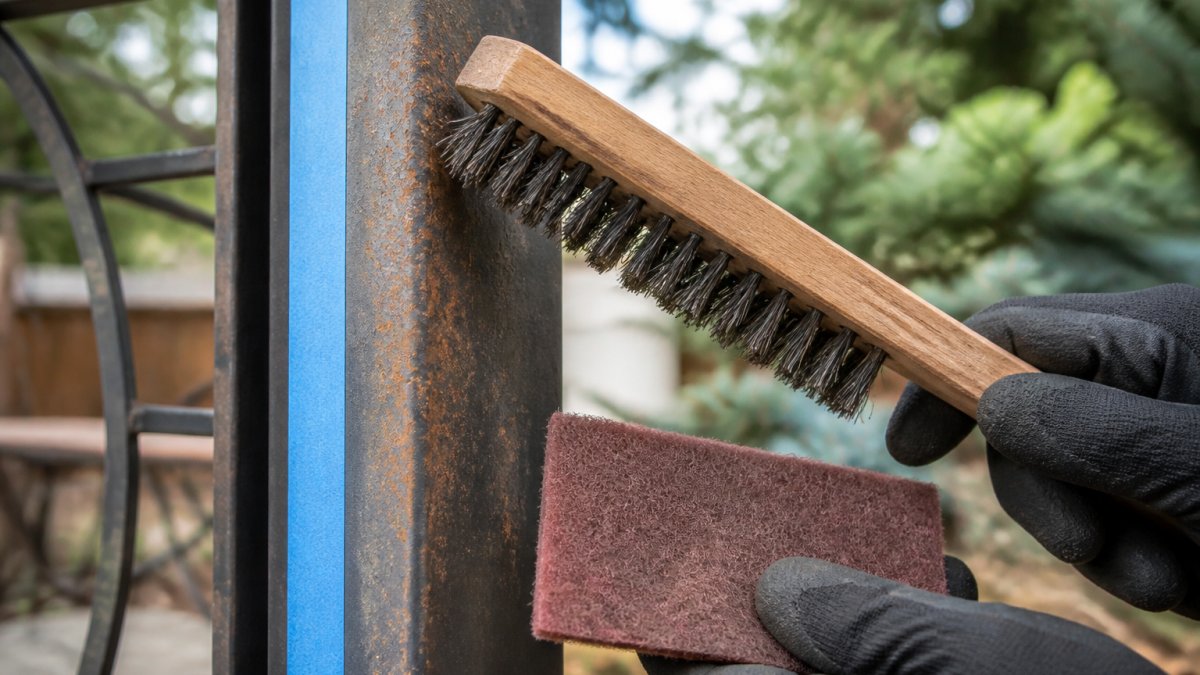
The right brush and abrasive depend on the rust level and the frame finish, as summarised below.
| Tool or abrasive | Best for | Key caution |
|---|---|---|
| Stainless-steel hand brush, brass or nylon bristles | Light surface rust and painted tube | Avoids deep scratches |
| Carbon-steel wire brush | Heavy flaking on unpainted structural sections | Never use on aluminum |
| Fine abrasive pad, 220-320 grit | Feathering paint edges after brushing | Blends cleaned area into coating |
| Wire wheel attachment for a drill | Moderate flaking on thicker sections | Keep moving with light pressure |
Using a Rust Remover for Metal on Stubborn Spots
When a wire brush will not lift the corrosion, a chemical rust remover does the work by converting or dissolving iron oxide. The two main product types behave very differently, and choosing the wrong one on a gazebo frame can etch aluminum, stain powder coat, or leave a surface that paint will not bond to.
Know which product you are reaching for
- Phosphoric-acid rust converter: Reacts with rust to form a dark, stable iron-phosphate layer that can be painted over. Best for pitted steel and joints where you cannot reach bare metal. It does not remove rust; it stabilizes it, so loose flakes must still be brushed off first.
- Chelating or acid-based rust remover (liquid or gel): Dissolves rust and lifts it from the surface, leaving bare metal. Gels cling to vertical tube and are easier to control on a frame; liquids work faster in soak applications but run on uprights.
- Evapo-Rust-style chelating soak: Non-acidic and safer around plants and skin, but it needs immersion or repeated wetting to work, which is impractical on an assembled frame unless you remove the part.
Application steps that actually hold up outdoors
- Prep the surface. Brush off loose flakes first. A remover applied over heavy scale only softens the top layer and wastes product.
- Mask what you are protecting. Tape off the canopy, curtains, patio pavers, and nearby plants with plastic sheeting. Most removers will etch concrete and kill grass if they run off.
- Test on a hidden spot. Apply a small amount to the inside of a leg or an inconspicuous joint and wait the full label dwell time. Watch for dulling on aluminum or blistering on powder coat.
- Apply in the label dwell window. Most gel removers need 15-30 minutes; converters often need 20-60 minutes before they turn dark. Do not let the product dry out mid-process; re-wet it with a spray bottle if it starts to skin over.
- Scrub and rinse. Use a nylon brush, not steel, to work the softened rust loose. Rinse with clean water and dry immediately with a rag; flash rust can form on bare steel within hours in humid conditions.
- Neutralize if the label requires it. Some acid removers call for a baking-soda wash before painting. Follow the label, then rinse again and dry.
Safety and handling
- Wear chemical-resistant gloves (nitrile is not enough for strong acids; check the product's SDS for the recommended glove type), splash goggles, and a respirator if the label calls for one.
- Work upwind and outdoors. Never use these products in a closed garage or under a sealed canopy.
- Keep a hose or bucket of clean water nearby for skin and eye rinses, and keep pets and children away from the work area until the surface is rinsed and dry.
Fixing Damaged Metal Before You Paint
Sometimes rust has eaten through the metal. Small holes or thin spots may need a patch or a metal repair product before you paint. Clean the area, fill the gap with an epoxy-based metal filler, and sand it smooth once it cures.
Larger damage calls for a different plan. A cracked leg or a joint that no longer holds firm usually needs a replacement part rather than a patch.
How to Paint a Metal Gazebo Frame So the Rust Stays Gone
Paint is what stops rust from coming back. Choose a rust-inhibiting primer made for metal, then add a durable outdoor topcoat.
Follow this order:
- Apply a thin coat of primer and let it dry fully.
- Add two thin topcoats rather than one thick coat, which can drip and crack.
- Pay extra attention to joints and bottom edges where water sits.
Thin, even coats hold up far better than heavy ones. Check the label for recoat times and temperature limits, and avoid painting in direct sun or damp weather.
For a longer-lasting finish, plan to inspect the frame once or twice a year. Touch up any new chips quickly so rust does not start in those spots.
Deciding Whether to Repair or Replace Your Gazebo Frame
Repair makes sense when the structure is still solid. If the rust is surface-level, the metal is thick, and the joints hold firm, cleaning and painting will likely give you years more use.
Replacement may be the smarter choice when:
- Several legs or rails have deep pitting or holes
- Joints wobble or no longer lock in place
- The frame has bent or cracked under load
If your canopy or curtains are also worn, you may only need replacement parts rather than a whole new gazebo. For replacement curtains and canopies that match your gazebo model, check the Gazebo Parts Direct website for current availability and pricing.
Frequently Asked Questions
How do you remove rust from a metal gazebo frame?
Start by inspecting the frame and brushing off loose flakes with a wire brush. Treat remaining rust with a rust remover made for metal, rinse, and let the surface dry completely. Then prime bare metal and apply a finish coat of outdoor-rated metal paint. Work in dry weather above the temperature range listed on the product label, and wear gloves, eye protection and a dust mask while sanding or brushing.
Can you use vinegar to remove rust from a gazebo frame?
White vinegar can loosen light surface rust on small steel parts if you soak them for several hours and then scrub. It is slow and inconsistent on heavy corrosion, and it leaves the metal wet and prone to flash rust if not dried right away. For a full frame, a commercial rust remover for metal or mechanical removal with a wire brush usually gives faster, more predictable results.
What is the best tool for removing rust from a thin metal gazebo frame?
A hand-held wire brush or fine abrasive pad is the safest choice for thin tubing, because power tools can grind through walls that are only a few millimeters thick. Use a light touch and check the wall thickness as you go. Avoid aggressive wire wheels on thin aluminum or lightweight steel, and stop once you reach sound metal rather than trying to remove every trace of pitting.
How do you prevent a gazebo frame from rusting again?
Clean and dry the frame at least once a year, touch up chips in the paint right away, and keep water from pooling in joints and hollow tubing. Store or cover the gazebo during heavy rain and snow seasons, and rinse off salt or fertilizer residue. A regular inspection schedule catches small spots before they spread.
