

Table of Contents
- Why Gazebo Canopies Lift in Wind and What Is at Risk
- Step 1: Choose Anchors That Match Your Surface
- Step 2: Add Weights, Guy Lines and Straps
- Step 3: Attach Anchors Securely to the Frame and Check Load Limits
- Should a Gazebo Stay Open or Closed in High Wind
- How to Keep a Canopy From Blowing Away at the Beach
- Booking Your Replacement Canopy or Frame Parts
- Frequently Asked Questions
How to Secure a Gazebo Canopy Against High Winds
Last Updated: November 8, 2026
Why Gazebo Canopies Lift in Wind and What Is at Risk
Wind is the main reason a gazebo canopy gets damaged, and it often happens faster than most owners expect, which is why a secure gazebo canopy starts with understanding the threat. Replacement canopies, bent frame legs, or broken roof beams are common after a single storm. Knowing how wind gets under a canopy is the first step to stopping it. Our guide on how to reinforce a gazebo frame for winter weather covers the frame-strengthening steps that also help prepare for storm conditions.
Wind pushes up under the fabric like a sail. The canopy catches air, and the frame has to hold that force. When the wind gusts, the lift can pull the legs right off the ground.
Here is what is at risk:
- The fabric: Gusts tear canopy panels, especially at the corners and seams.
- The frame: Bent legs and cracked joints weaken the whole structure.
- The roof beams: Heavy loads can crack or snap a support beam.
- The whole gazebo: A lifted frame can tip, slide, or blow across the yard.
A gazebo with a light frame and a large roof is the easiest to lift. Gazebos on hard surfaces are also at risk, because there is often nothing to drive stakes into.
Step 1: Choose Anchors That Match Your Surface
The right anchor depends on what the gazebo sits on, how compact the ground is, and how much load the frame can take. Grass and soil hold stakes well only when the soil is firm. Concrete, pavers, and decking need a different method. Sand and loose fill hold almost nothing. Start by checking the surface under each leg, then pick anchors that match.
- Firm grass or soil: Use steel spiral stakes or long tent stakes driven at an angle away from the gazebo.
- Loose, sandy, or wet soil: Use longer stakes, add leg weights, or switch to a ballast method.
- Concrete or pavers: Use anchor kits made for hard surfaces, or add heavy weights to every leg.
- Decking: Use deck anchors that clamp to the boards or joists, or use weights; do not drill into a deck you do not own.
- Mixed surfaces: Use the method that suits the hardest surface and check each leg separately.
Anchoring on Grass and Soil
Soil can hold a stake, but only if the stake goes deep enough and the ground is compact. Drive steel spiral stakes into the ground at an angle away from the gazebo, then tie the leg to the stake with a strap or rope. A common pattern is to angle the stake so the pull from the canopy drives it deeper rather than pulling it out. Check each stake after a few hours, because loose soil can shift in heavy rain.
Soft, wet ground loses grip quickly. In that case, use longer stakes or add weight to the legs. If the ground is sandy or recently tilled, treat it like a loose surface and rely on ballast first.
How to Hold Down a Canopy Tent on Concrete
Concrete cannot take a stake, so a secure gazebo canopy on this surface needs weight or a hard-surface anchor. Many owners use anchor kits that bolt or clamp to concrete. Others place sandbags or water barrels on each leg. A common mistake is adding weight to only one or two legs. Wind can still lift the other corners, so every leg needs ballast.
Watch out: A hard-surface anchor kit must be rated for the pull load of your canopy; a kit sized for a small pop-up may not hold a larger gazebo frame.
Anchoring on Decking and Sand
Decking is a middle case. You can clamp to the boards or joists if the deck is yours and the hardware is rated for it, but most renters and event setups should use weights instead. Sand is the hardest common surface: stakes pull out, and bags slide. Use wide sandbags or heavy weights on every leg, and bury the bags partly in the sand for extra grip. Set the gazebo up with the open sides facing the wind so the wind passes through more easily.
The right anchor depends on the surface under each leg, so this quick reference shows which method fits each one.
| Surface | Recommended anchor | Watch out for |
|---|---|---|
| Firm grass or soil | Steel spiral stakes or long tent stakes, angled away | Check stakes after a few hours |
| Loose, sandy, or wet soil | Longer stakes, leg weights, or ballast | Soil can shift in heavy rain |
| Concrete or pavers | Hard-surface anchor kits or weights on every leg | Kit must be rated for canopy pull load |
| Decking | Deck anchors clamped to boards or joists, or weights | Do not drill into a deck you do not own |
| Sand | Wide sandbags or heavy weights, partly buried | Stakes pull out and bags slide |
Step 2: Add Weights, Guy Lines and Straps
Anchors alone may not be enough in strong wind. If your canopy already sags, fix the sagging fabric and tension before adding wind protection. Weights and straps add extra holding power and spread the load across the frame.
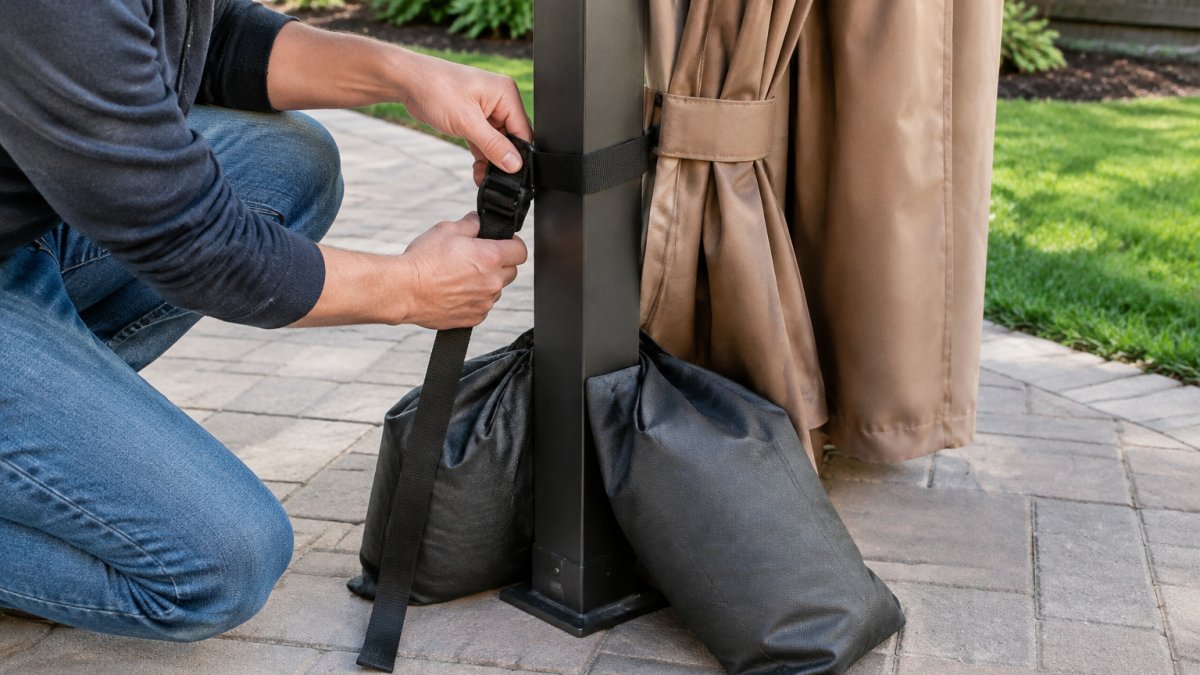
- Leg weights or sandbags: Place them on each leg, not just the corners you can reach.
- Water barrels: Fill them completely for the most weight, and secure them to the leg.
- Guy lines and ropes: Run lines from the roof corners down to stakes or weights.
- Tie-down straps: Use them to connect each leg to an anchor point.
Set up weights and straps before a storm arrives. Hands tying a tie-down strap to a gazebo leg, with sandbags resting against the base, is a good way to see how it should look.
Watch out: Do not hang extra weight from the roof itself. That can bend the frame and make lift worse.
Step 3: Attach Anchors Securely to the Frame and Check Load Limits
Anchors only work if they connect to a strong part of the frame. Attach straps and lines to the legs or corner brackets, not to thin fabric or loose trim.
Check the frame before you add load. If a support beam is weakened, this guide walks you through replacing a gazebo roof support beam safely. Look for bent legs, cracked joints, or rusted connections. Replace any damaged roof support beam before you rely on the frame in high wind.
Also check the manufacturer's load limits. Adding too much weight can damage a frame that looks fine. If you are unsure whether your frame is strong enough, contact a parts specialist with your model details.
Should a Gazebo Stay Open or Closed in High Wind
A closed canopy catches more wind than an open one, so keep the sides down only if the gazebo is well anchored. Many owners take the side panels off or roll them up during gusts. The harder question is when anchoring stops being enough. A canopy rated for occasional gusts is not a storm shelter, and the manufacturer's wind rating is the limit to follow, not a target to test.
Here is a practical way to decide, using the canopy maker's specifications as the ceiling:
- Light breeze (roughly under 15 mph): Keep the canopy up with all anchors in place, and check straps and stakes.
- Moderate wind (roughly 15-25 mph): Open or remove the sides, re-tension guy lines, and watch the frame for flexing or lifting legs.
- Strong gusts (roughly 25-35 mph): Add ballast if you have it, but plan to take the canopy down; many frames are not rated for sustained wind in this range.
- Dangerous gusts or a storm warning (above roughly 35 mph, or any severe-weather watch): Take the canopy down before the wind arrives. Do not wait to see whether the anchors hold.
These bands are general guidance, not a substitute for the maker's rating. A light-frame gazebo with a large roof may need to come down at the lower end, while a heavier frame with a proper anchor kit may handle more. If you do not know your model's wind rating, assume the lower threshold.
Before and during use, inspect the setup: check that every stake is still driven, every strap is tight, and no leg has lifted. Look for bent legs, cracked joints, or rusted connections, and replace any damaged roof support beam before you rely on the frame in high wind. If the wind rises above what your gazebo can handle, the safest choice is to take the canopy down. Storm damage from a lifted canopy costs far more to fix than a few minutes spent dismantling. Replacement fabric and frame parts are available when you need them, and replacing damaged roof or frame parts is often cheaper than rebuilding the whole structure.
How to Keep a Canopy From Blowing Away at the Beach
Beach sites are harder than most yards. Sand does not hold stakes well, and wind is often stronger near the water.
Use wide sandbags or heavy weights on every leg, and bury the bags partly in the sand for extra grip. Bring rope and straps so you can tie each leg to a fixed object, if the beach rules allow it. Set the gazebo up with the open sides facing the wind, so the wind passes through more easily.
Watch the forecast. Beach wind can change quickly, so plan to take the canopy down before the afternoon gusts start.
Booking Your Replacement Canopy or Frame Parts
Sometimes wind damage is too much to repair. A torn canopy, a cracked beam, or a bent leg may need a full replacement part.
Gazebo Parts Direct carries replacement canopies, curtains, mosquito netting, and frame parts for major gazebo brands. Our team offers expert fitment assistance to help you match a part to your model. Find the right replacement canopy or frame part for your gazebo, and check the model details before you order.

Pricing depends on quantity, dates, and delivery. Visit the Gazebo Parts Direct website for current prices or a quote.
Frequently Asked Questions
How do I keep a gazebo canopy from blowing away?
Anchor every leg, not just two or three. Use ground stakes or sandbags on grass and soil, and weights or water barrels on hard surfaces. Add guy lines or straps to the frame so the canopy cannot lift from the top. Check the tension after the first gust, because fabric can loosen as it stretches. If the forecast calls for sustained winds you cannot control, take the canopy down rather than hoping the anchors hold.
How do I hold down a canopy tent on concrete?
Concrete cannot take ground stakes, so use weight-based anchoring. Fill each leg weight or sandbag with enough mass to resist lift, and attach them with the leg's built-in hooks or straps. Water barrels work well when filled completely. For a more secure option, use concrete anchor kits that fasten to the slab with masonry screws. Check each anchor point before storms and after any movement.
Should a gazebo canopy be open or closed in high winds?
Close the canopy or lower the sidewalls only when the wind is light and you have properly anchored it. Open or partially open canopies catch more air and lift more easily. In high winds, the safer choice is usually to take the canopy down completely, since sidewalls and tops act like sails and can overload the frame.
Can a canopy withstand 10 mph winds?
A properly anchored canopy with all legs secured can typically handle light breezes around 10 mph, but manufacturer ratings vary by model and setup. Light-duty canopies with thin frames are more vulnerable. Check your product's wind rating, and remember that gusts can be much stronger than the sustained speed shown in a forecast. When gusts rise, dismantle the canopy to protect the frame and fabric.
