

Last Updated: November 1, 2026
Quick Summary
Gazebo frame rust forms when iron in steel reacts with oxygen and moisture, usually where rain, dew, or ground water collects on the metal. Scratches in the paint expose bare metal, which speeds corrosion, and the legs near the ground corrode first. Inspect the frame twice a year and touch up chips quickly to prevent it.
- Rust needs iron, oxygen, and moisture, so keep water from sitting on the frame.
- Gazebo frames rust fastest at the base, where the legs meet the ground.
- Inspect the frame at least twice a year, once in spring and once before winter.
- Touch up paint chips as soon as you spot them to expose no bare metal.
- Replace any part that is perforated or sags, and patch only shallow surface rust.
Table of Contents
- Why Gazebo Frames Rust: How the Corrosion Process Works
- Steel vs Aluminum Gazebo Frames: Which Rusts and Which Does Not
- How to Inspect Your Gazebo Frame for Rust and Weak Spots
- How to Remove Rust from a Metal Gazebo Frame, Step by Step
- Gazebo Frame Rust Repair: When to Repair and When to Replace
- How to Prevent Rust on a Steel Gazebo Frame Before It Starts
- Keep Your Gazebo Frame Rust-Free: Your Next Steps
- Frequently Asked Questions
Why Gazebo Frames Rust: How the Corrosion Process Works
If you've noticed orange flecks on your gazebo legs, you're not alone.
Rust is a form of corrosion, and it needs three things to form: iron, oxygen, and moisture. When water sits on or inside the metal, it carries oxygen to the surface. The iron then oxidizes, and that reddish-brown crust starts to spread.
Here's what speeds the process up:
- Rain and morning dew left sitting on the frame
- Scratches or chips in the paint that expose bare metal
- Salt air near coastal areas
Gazebo frames rust fastest at the base, where legs meet the ground. Ground moisture wicks up the metal, so the bottom few inches often corrode first.
Watch out: Ignoring small spots is the most common mistake. A few specks of rust can turn into a hole in one season, especially on thin-walled tubing.
Steel vs Aluminum Gazebo Frames: Which Rusts and Which Does Not
Steel frames rust. Aluminum frames generally do not, at least not in the same way. Aluminum forms a thin oxide layer that protects the metal underneath, which is why it resists the red rust you see on steel.
That said, the two materials need different care:
- Steel: Strong and affordable, but it needs a protective coating to resist rust.
- Aluminum: Lightweight and naturally rust-resistant, but it can still pit or corrode when exposed to salt or harsh cleaners.
Many gazebo frames are powder-coated steel. The coating is the first line of defense, so a chip in that finish is where rust usually starts.
How to Inspect Your Gazebo Frame for Rust and Weak Spots
Check your frame at least twice a year, once in spring and once before winter.
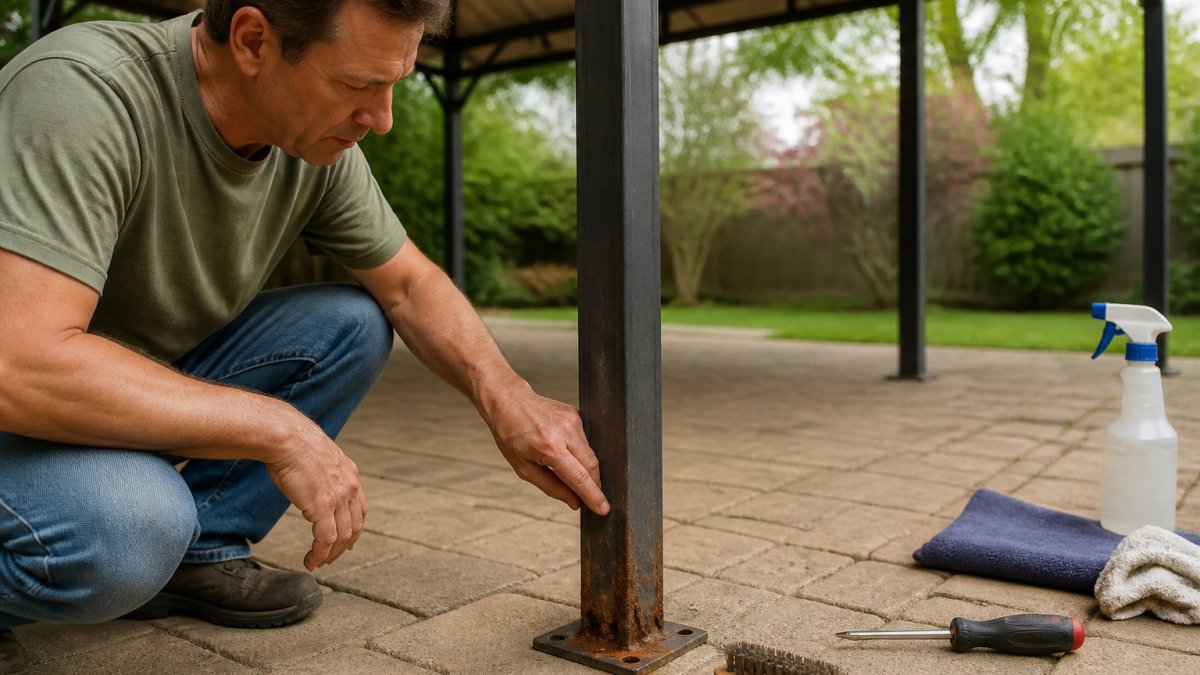
Walk around the frame and look for these signs:
- Orange or brown spots on the legs or roof supports
- Bubbling or flaking paint
- Dark, soft-feeling areas when you press the metal
Pay special attention to joints, bolt holes, and the inside of tube ends.
Tap the metal lightly with a screwdriver handle. A dull thud instead of a clear ring can mean thinning metal underneath.
!A homeowner crouching beside a backyard steel gazebo, running a hand along a leg near the base where rust spots show
How to Remove Rust from a Metal Gazebo Frame, Step by Step
Removing rust is a sequence, not a single product. Work on one section at a time on a dry day when the temperature is between roughly 50°F and 85°F and humidity is below 70%, most coatings will not cure properly outside that window. Plan on a full weekend for a whole frame, since each coat needs its own dry time.
Grill Gazebo 8 x 5 Double Tiered Outdoor BBQ Gazebo Canopy with LED Light →
- Wash and degrease. Scrub the frame with mild dish soap and water, then wipe with a degreaser or denatured alcohol. Paint and primer will not bond to oil, pollen film, or sunscreen residue. Rinse and let it dry completely, trapped moisture under a coating is the most common cause of a re-rust.
- Remove loose rust and failed coating. Use a wire brush, a 60- to 80-grit flap disc on a drill, or 80-grit sandpaper. Take off every flake, blister, and chalky patch until you reach firm metal or tightly adhered paint. Feather the edges of the surrounding paint so the repair does not leave a ridge.
- Sand to a profile. Switch to 120- to 180-grit paper and scuff the bare metal and a 1- to 2-inch border of intact paint. Coatings grip a scratched surface far better than a polished one. Wipe with a tack cloth.
- Treat what remains. For light surface rust in pits, apply a phosphoric-acid rust converter per the label and let it cure to a black or gray stable film. Do not converter-treat heavy scale, remove that mechanically first. On aluminum, skip acid converters entirely; they can pit the metal. Use a non-acidic aluminum cleaner and a nylon brush instead.
- Prime bare metal. Apply a rust-inhibiting metal primer, zinc-rich for steel, zinc chromate or an epoxy primer for aluminum, within the recoat window on the can, usually 1 to 24 hours depending on product. Two thin coats beat one thick coat.
- Topcoat. Apply a rust-resistant exterior enamel or direct-to-metal (DTM) coating in thin, even passes, following the manufacturer's recoat and full-cure times. Most need 24 to 72 hours before full water exposure; do not rush this before the next rain.
- Seal the seams and fasteners. After the topcoat cures, apply a bead of exterior-grade silicone or polyurethane sealant at joints, bolt heads, and tube ends where water pools. Replace any rusted bolts with stainless or hot-dip galvanized fasteners.
Safety first. Wear nitrile gloves, safety glasses, and a NIOSH-rated respirator when sanding or spraying; rust dust and solvent vapors are both hazards. Work upwind, and keep solvents away from the canopy fabric, which can stain permanently.
Choosing Rust Treatment Products for Each Stage
Match the product to the metal and the stage, not just the label:
- Painted steel: 80-grit paper or wire brush → phosphoric-acid rust converter → zinc-rich metal primer → exterior enamel or DTM topcoat.
- Galvanized steel: Do not sand through the zinc layer. Clean with a vinegar or commercial galvanized-surface prep, then apply a primer formulated for galvanized metal (ordinary primer will not adhere) before topcoating. Touch up bare spots with a zinc-rich cold galvanizing compound.
- Aluminum: Non-acidic cleaner and nylon brush → etch primer or epoxy primer → polyurethane topcoat. Avoid steel wool, which leaves particles that rust and stain the aluminum.
Choose products labeled for exterior metal use, check the recoat window on every can, and keep a small touch-up kit of primer and matching topcoat on hand so chips get sealed the same week they appear.
The table below summarises the stages of rust removal and the products each metal needs, so you can match each step to your frame.
| Stage | Painted steel | Aluminum |
|---|---|---|
| Clean | Mild dish soap, degreaser | Non-acidic aluminum cleaner |
| Remove rust | 60-80 grit flap disc or wire brush | Nylon brush, no steel wool |
| Sand to profile | 120-180 grit paper | 120-180 grit paper |
| Treat rust | Phosphoric-acid rust converter | No acid converter |
| Prime | Zinc-rich metal primer | Etch or epoxy primer |
| Topcoat | Exterior enamel or DTM coating | Polyurethane topcoat |
Gazebo Frame Rust Repair: When to Repair and When to Replace
Most rust advice stops at "repair small spots, replace big ones." That is not a decision you can act on. Use corrosion depth, perforation, joint condition, and structural role to decide, and treat any load-bearing member differently from a cosmetic one.
Measure the corrosion, not the stain
Rust stains spread far beyond the actual damage. Probe the metal, don't just look at it:
- Surface rust: orange film that wipes off and leaves sound metal underneath. Repair it.
- Pitting: small craters you can feel with a fingernail but that do not go through. Repair if the wall is still more than about half its original thickness; replace if pitting is clustered at a joint or foot.
- Perforation: a screwdriver or awl pushes through, or you can see daylight through a pinhole. Replace that member, patching thin-wall tubing rarely holds.
Repair when
- Rust is surface-level or shallow pitting and the metal rings clear when tapped with a screwdriver handle.
- Damage is confined to one leg, one roof support, or a cosmetic skirt, and the rest of the frame is sound.
- Joints, bolts, and welds are tight and show no cracking or separation.
Replace the part when
- A single leg, foot, corner bracket, or roof rib is perforated but the rest of the frame is solid. Replacement parts are often less costly than a new structure and can preserve the fit of the existing canopy.
- Fasteners are seized or rusted through, replace bolts with stainless or hot-dip galvanized hardware rather than reusing them.
- The foot or base plate has rusted where it meets concrete or soil; this is the highest-corrosion zone on nearly every frame.
Replace the whole frame when
- Two or more legs or primary roof members are perforated or visibly bowed.
- The frame sags, racks, or wobbles when you push a corner, that is a structural warning, not a cosmetic one.
- Rust has reached welds at multiple joints, or the tube interiors are packed with scale (tap along the tube; a dull, crunchy sound means internal corrosion).
Material-specific repair limits
- Painted steel: repairable up to shallow pitting; perforation means replacement because patches on thin wall do not carry load.
- Galvanized steel: the zinc layer sacrifices itself, so localized white or red rust often means the coating is spent in that spot, clean, prep, and recoat with cold galvanizing compound before topcoating. Through-wall rust still means replacement.
- Aluminum: it does not red-rust, but white powdery corrosion and pitting at joints and fasteners signal galvanic attack, often where steel bolts meet aluminum. Replace corroded fasteners with aluminum or stainless isolators; deep pitting at a joint warrants replacing that member.
If only one part of the frame is damaged, a replacement part is usually the better choice than buying an entire new structure.
How to Prevent Rust on a Steel Gazebo Frame Before It Starts
Prevention is far easier than repair. A few habits go a long way.
- Wipe down the frame after heavy rain or salt exposure.
- Keep grass, leaves, and soil away from the legs.
- Store the canopy and frame dry during off-season months.
Climate matters. Humid, coastal, or snowy areas expose frames to more moisture and salt. In these places, inspect more often and touch up coatings earlier.
Keep Your Gazebo Frame Rust-Free: Your Next Steps
Start with a quick inspection this week. Look at the leg bases and joints first, since those spots rust fastest. If you find surface rust, follow the removal steps above and treat it right away.
If a part is too damaged to repair, Gazebo Parts Direct can help you find a replacement that fits your model. Our team offers fitment help, fast shipping, and a wide inventory of canopies, so you can get your gazebo back in good shape without starting over.
Frequently Asked Questions
Why is my gazebo frame rusting?
Gazebo frames rust when bare or chipped steel is exposed to moisture and oxygen, which starts the oxidation process that forms iron oxide. Rain, dew, and humidity collect in joints, bolt holes, and the bottom of legs where water stays longest. Once the powder coating or paint is scratched or worn through, rust can begin within weeks in wet climates. Checking the frame after storms and seasonal changes helps you catch the first spots before they spread.
Does an aluminum gazebo frame rust?
Aluminum does not rust in the way steel does, because it forms a thin oxide layer that protects the metal underneath. However, aluminum can still corrode, especially where it contacts dissimilar metals, dirt, or salt-laden air. Steel frames need the protective coating to stay intact, while aluminum frames mainly need cleaning and occasional inspection of joints and fasteners.
Can you repair rust on a gazebo frame?
Light surface rust can usually be removed by wire brushing or sanding, followed by a rust-inhibiting primer and a topcoat of exterior paint. Deep rust that has created holes or thinned the tube wall weakens the structure and is harder to fix safely. If a leg or joint has lost significant material, replacing that component is more reliable than patching it. Check the structure for wobble after repairs before using the gazebo for events.
How often should I inspect a gazebo frame for rust?
Inspect the frame at least twice a year, once in spring after the weather warms and once in fall before storage or winter weather. Also check after heavy rain, hail, or storms. Focus on the leg bases, roof joints, bolt holes, and any spot where the coating looks chipped or dull. Catching rust early keeps repairs simple and prevents damage to the frame's structural strength.
