

Quick Summary
Yes, in most cases you can replace a gazebo canopy without replacing the frame, because the canopy is a separate fabric roof that fastens to the frame with straps or fasteners. The key is matching the new canopy to your exact model, since two canopies with the same listed size can still fail to fit.
- Identify your model number first, using the label, frame post sticker, or original manual.
- Measure the frame itself, not the old canopy, which may have shrunk or stretched.
- Check frame shape, roof type and attachment style, not just the listed size.
- Inspect the frame for rust, loose joints and bent rafters before buying fabric.
- Tighten straps in two passes and re-check them after the first rain and windy week.
Table of Contents
- Yes, You Can Replace a Gazebo Canopy Without Replacing the Frame
- How to Identify Your Gazebo Model Before Ordering
- How to Measure a Gazebo Frame for a Replacement Canopy
- Are Gazebo Canopies Interchangeable? Why Size Alone Is Not Enough
- Checking Frame Condition Before You Replace the Canopy
- Gazebo Canopy Installation, Step by Step
- Booking Your Replacement Canopy Order with Gazebo Parts Direct
- Frequently Asked Questions
Yes, You Can Replace a Gazebo Canopy Without Replacing the Frame
In most cases, the canopy and the frame are separate parts. The canopy is the fabric roof that attaches to the top of the frame with straps or fasteners.
Replacement canopies for popular models are sold on their own.
The real question is not whether you can swap the canopy, but whether the new one fits. Keep reading to learn how.
How to Identify Your Gazebo Model Before Ordering
Model identification is the first step, and many buyers skip it.
If you cannot find a number, use what you can see. Note the frame shape (round, square, or hexagon), the roof style (single-tier or two-tier), and any ornaments.
Gazebo Parts Direct offers fitment help. Send a photo of the frame or your model number so the team can help identify the correct canopy.
How to Measure a Gazebo Frame for a Replacement Canopy
Measure the frame, not the old canopy. You can follow the dedicated guide on measuring a gazebo for a replacement canopy for the full process. An old canopy may have shrunk, stretched or been altered over time.
- Footprint: Measure the width and depth of the frame at the base, from post to post.
- Height: Measure from the ground to the top of the roof peak.
- Eave and overhang: Measure how far the roof extends past the posts, if it does.
Write each number down in feet and inches. Then compare these measurements with the listed frame size for the replacement you want.
Are Gazebo Canopies Interchangeable? Why Size Alone Is Not Enough
No, not always. Two canopies can have the same listed size and still fail to fit. Matching dimensions is necessary, but it does not confirm compatibility.
A common mistake is buying a canopy that is the right width but has the wrong attachment layout. Straps placed at different points will leave the fabric sagging, or it will not seat on the frame at all.
Check the model details, not only the size.
Checking Frame Shape and Roof Design
Compare these features against the listing before you order:
- Frame shape: Hexagon, octagon, round or square frames need different panel layouts.
- Roof type: Single-tier and two-tier roofs have different fabric patterns.
- Ornaments and trim: Finials and scroll designs can affect where the fabric sits.
Universal, Custom, and Model-Specific Options
You have three general options, and the right one depends on how closely you can identify the frame and how much you are willing to spend.
Replacement Canopy for Hex Gazebo - RipLock 350 →
- Universal canopies fit a broad range of frames but may leave gaps or loose fabric. They are the cheapest option and the fastest to ship, but they rely on adjustable straps and tie-downs rather than a cut-to-shape pattern. They work best on simple square or rectangular frames with a single-tier roof and no ornaments.
- ** This is the right path when the frame is sound but the model is discontinued or was never labeled.
- Model-specific canopies are built for one named model and give the closest fit. They arrive with the correct panel count, seam angles, and fastener positions, so installation is mostly a matter of lifting and fastening rather than adjusting. For most homeowners, a model-specific canopy is the safest choice when you can identify the model. Gazebo Parts Direct sells model-specific replacements, including the 84C-210 10-by-12-foot model canopy at $229.73.
A practical way to decide: if you can find a model number, buy model-specific. If you cannot find a number but the frame is a common shape, call the seller with photos before defaulting to universal.

Why an Exact Replacement May Be Unavailable
Even a well-known brand can stop producing a canopy years before the frame wears out. When that happens, the frame is often still serviceable, but the original pattern is gone. In that situation, the realistic choices are a universal cover with adjustable fasteners, a custom cover sewn to your measurements, or a new gazebo. Weigh the cost of each against the remaining life of the frame: a frame with surface rust at the joints but straight rafters is usually worth re-covering, while a frame with bent rafters or soft wood is not.
Checking Frame Condition Before You Replace the Canopy
Before you spend money on fabric, inspect the frame. A new canopy will not last on a damaged structure.
Look for rust or cracks at the joints, loose bolts, bent rafters, soft or rotting wood, and posts that wobble when you push them. If the frame moves or sags, repair or brace it first. Replacing a canopy on a weak frame can strain the fabric and create a safety risk in wind or heavy snow.
Gazebo Canopy Installation, Step by Step
Plan for an hour or two with a helper. The work is easier with two people, and on a two-tier roof it is close to impossible alone. Pick a calm, dry day: fabric is easier to handle when it is not wet, and you do not want wind loading the cover while you are still fastening it.
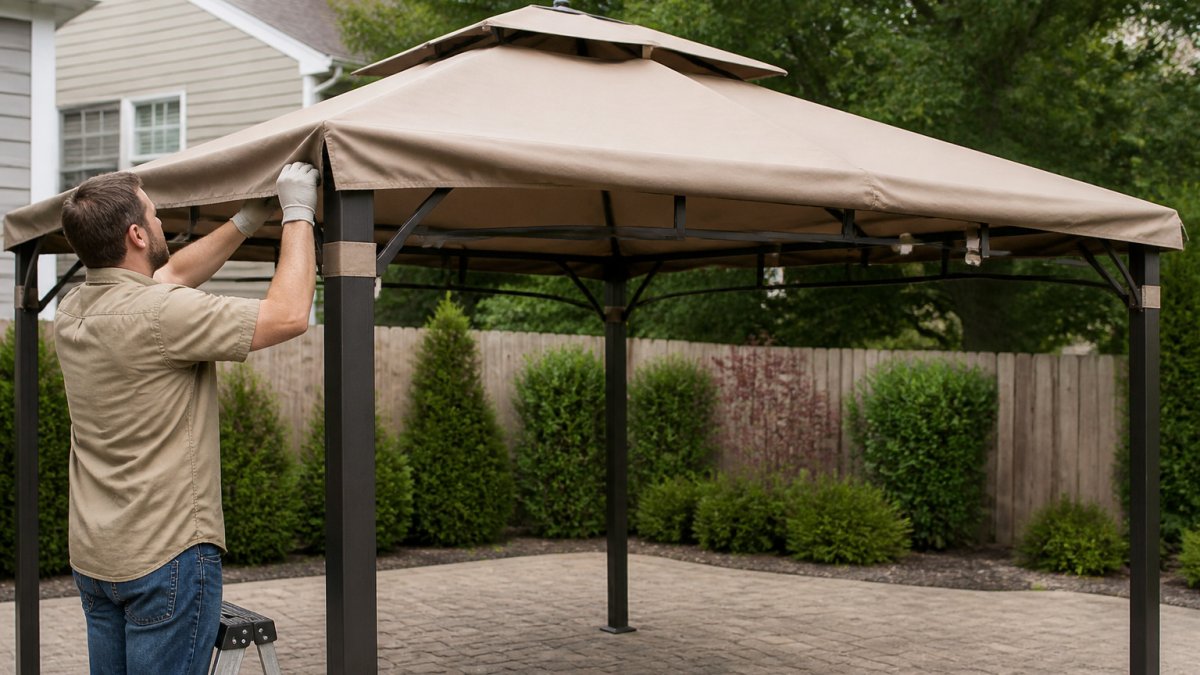
- Clear the area. Remove furniture and any curtains or screens from under the roof. Lay a clean tarp on the ground beside the gazebo so the new canopy has somewhere to rest without picking up grit.
- Remove the old canopy. Unfasten the straps and corner pockets, then lower the fabric carefully. Work from the top down on a two-tier roof: release the upper tier first, then the lower panels. Keep every strap, buckle, and fastener in a labeled bag; replacement covers do not always ship with new hardware, and matching a discontinued buckle can be harder than matching the fabric.
- Check the frame. Confirm it is level and secure, as described above. Run a hand along each rafter and post joint for cracks, and tighten any bolt that turns freely. This is also the moment to touch up bare metal with a rust-inhibiting paint, because a new cover will hide the spot until it has spread.
- Lay out the new canopy. Match the front and back to the frame using any markings on the fabric. If the cover has no markings, identify the corner pockets and compare their spacing to the frame corners before lifting.
- Lift and position. Raise the canopy over the frame with a helper, centering it on the roof. On a hexagon or octagon, start with one panel aligned to one roof section and work around rather than trying to center all sides at once.
- Attach the straps or pockets. Start at the corners and work around the frame. Keep the fabric taut as you go, but do not lock down the first corner fully before the opposite corner is seated; leaving a little slack in each fastener until all corners are engaged lets the fabric settle square.
- Adjust for fit. Check that the roof lies flat, with no large gaps or sagging panels. Then go back around and tighten each strap or tie in small increments, alternating sides, until the cover is evenly tensioned. A cover that is tight on one side and loose on the other will pull its seams apart over a season.
- Test it. Push gently on the roof and confirm nothing shifts. Then check the underside: if a strap is rubbing against a sharp frame edge, pad it with a strip of weather-resistant foam or wrap the edge with tape before the rub wears through the fabric.
A common mistake is fastening all the corners at once without adjusting the tension. Work evenly around the frame so the fabric stays square. A second common mistake is over-tightening: a cover stretched past its cut pattern will pull the corner pockets off the frame or split a seam in the first cold snap.
Handling Fasteners and Tension
Most replacement canopies use one of three attachment styles: Velcro straps that wrap around the rafters, corner pockets that slip over the post tops, or ties that knot through grommets. Velcro is the most forgiving of small measurement differences but loses grip as it ages and collects lint; clean the hook side with a stiff brush once a season. Corner pockets give the cleanest fit but demand an exact match, because a pocket that is an inch off will not seat. Ties are the most adjustable and the least weather-tight, so check them after every storm.
Whichever style you have, tension the cover in two passes: a light pass to seat every fastener, then a firm pass to remove slack. This two-pass method is what keeps a cover from developing a low spot that pools water.
After the First Rain and the First Windy Week
A new canopy stretches slightly as it settles. Walk around the frame after the first hard rain and again after the first windy week, and re-tighten any strap that has gone slack. Check the corner pockets for wear where they meet the frame, and confirm that no seam is pulling.
The installation steps below come with a rough time for each stage, so you can plan the work.
| Step | What to do | Time or frequency |
|---|---|---|
| Plan the job | Pick a calm, dry day with a helper | One to two hours |
| Remove old canopy | Release straps and pockets, top tier first | During removal |
| Check the frame | Confirm it is level and secure | Before fitting |
| Lay out new canopy | Match front and back to frame markings | Before lifting |
| Attach straps or pockets | Start at corners and work around | During fitting |
| Adjust for fit | Tighten in small steps, alternating sides | Until evenly tensioned |
| Test the install | Push the roof, pad any rubbing strap | Final check |
| Re-check after weather | Tighten slack straps after rain and wind | After first rain and first windy week |
Booking Your Replacement Canopy Order with Gazebo Parts Direct
If you have identified your model and confirmed the frame is sound, you are ready to order. Gazebo Parts Direct carries replacement canopies for hexagon and curved-roof models, along with fitment help if you are unsure. Check the product listing for the exact frame size, roof type and attachment style, then add the canopy to your cart.
Frequently Asked Questions
Are gazebo canopies interchangeable?
Not always. Two canopies can look the same size and still fail to fit because roof shape, number of tiers, overhang style and attachment points differ between models. Compare the replacement's listing with your existing model number and frame measurements before you buy. Gazebo Parts Direct offers fitment help, so you can send a photo of your frame or your model number before you order.
How do I know if my gazebo model is compatible with a replacement canopy?
Start by finding the manufacturer's model number, usually on a label on a support post, under the roof or in the original packaging. Note the frame size, roof type (single-tier, two-tier or hexagon) and any signature features such as a finial or curved roof. Match these details to the model listed on the replacement page. If you cannot find a model number, send Gazebo Parts Direct a photo of the frame so the team can identify it.
Can I use a canopy without the original frame?
A canopy needs a frame to attach to and hold its shape. Without the frame, the fabric cannot be secured properly and may sag, tear or blow away in wind. You can, however, reuse a sound frame with a new canopy. Replacing only the canopy is the usual approach when the metal or wood structure is still solid.
